This blog provides information, stories, links and events relating to and promoting the history of the Wimmera district.
Any additional information, via Comments, is welcomed.


Tuesday, 28 November 2023

Home in the Glen

"Former restaurant and residence in Horsham 'Glen Logan' on the market

If you head along Dooen Road in Horsham, there's an imposing two storey red-roofed homestead that will probably catch your eye.

That's Glen Logan, a historic house which has been a major landmark in the city's east for almost one hundred years.

It has connections to several prominent Wimmera families (the Boltons, Langlands and Cranages) and has recently been put on the market.

The agent in charge of the sale, Gerry Smith, told ABC presenter Rebekah Lowe about the history of Glen Logan."

Article and audio from ABC Wimmera Radio.  Audio here

Photos from HRE Horsham Real Estate


Have seen some beautiful wedding photographs taken at Glen Logan back when the front facade of the building was covered in Boston ivy. 

Have been to functions, even presented functions there - Glen Logan is an institution in Horsham, and hopefully it will get a buyer with plans to continue the tradition.

Tuesday, 27 June 2023

Jeparit World War One German dugout

"The surprising discovery of a German dugout was made in the sandhills north of Jeparit in late May 1916.

The local police received word on Sunday, 29 May, of the existence of a German dugout believed to be occupied by escapees from the military internment camp at Langwarren, south-east of Melbourne, who had been on the run for the last 10 months.

To investigate the site, the police travelled by car 4 miles north of the township on the main Jeparit-Rainbow Road before they had to then walk half a mile across a field of stubble, an area of heavy sand riddled with rabbit warrens, and then had to force their way through thick scrub to locate the site, but the occupants had already fled when they arrived.

The site was well-concealed but commanded a view of the surrounding farmland for miles, including the main road and railway.

This discovery caused a sensation, and with the landowner’s co-operation, onlookers travelling across the district were charged one shilling to inspect the site, with the proceeds being donated to an appropriate patriotic cause.

Although its exact location has now been lost, the structure was described as similar to dugouts constructed by the Germans in the trenches of the Western Front in France and Belgium and was described as clean and comfortable.

The horizontal wooden entry door that opened on a sliding mechanism was well concealed in a clump of mallee scrub, revealing a ladder leading down into a room 7 feet deep, 10 feet long, and 8 feet wide. Four large pine uprights supported a roof constructed of cross timbers, over which cornsacks had been placed and covered with soil. The sand and clay excavated to make the chamber had been spread over a wide area to make it harder to detect, and the space immediately over the roof had been covered with scrub.

The walls were lined with timber from kerosene cases and hessian, and 3 tin funnels were in the roof for ventilation. Two hammocks made of bags were suspended from the central uprights and attached to the walls, and an improvised table and shelves made up the furnishings.

The room contained German newspapers from 1914, playing cards, candles, and empty beer bottles. The walls were decorated with a large amount of German writing, and a signboard inside the door stated, “Home of Deserter and Prisoner of War, 1916”, and "The recruiting officer Kaiser Bill der Grosse”. There was also an intricately carved resemblance of the Kaiser and a drawing of a German officer in uniform.

The room was clean and tidy, although carefully hidden around the site were remnants of rabbits, turkeys, and sheep that had been consumed as food.

The alleged residents, both with German heritage, were Max Langer, who had been arrested in July 1915, in Jeparit for failing to report his movements to the police, and Max Zimmerman, who was arrested for the same reason in Maffra and were interned at a camp at Langwarren from where they escaped together in August 1915.

Once free from the camp, they made their way to Jeparit, where Langer had previously worked and knew the area well. Here they believed that amongst the significant population of German settlers, they would find help to elude pursuit by the police. However, knowing that the appearance of unknown Germans in the town would arouse suspicion, they decided to hide until the coming harvest period by constructing a hiding place in the sand hills between Jeparit and Ellam to a design that they had seen while at Langwarren, which also resembled the dugouts in the German trenches on the Western Front.

While hiding, they survived by trapping wild birds and rabbits and venturing into the fields under cover of darkness to seek food. Evidence was found in the abandoned dugout incriminating several locals who had assisted the fugitives.

Once the usual surge of swagmen and itinerant workers arrived for the harvest, they could break cover without being too conspicuous and seek work on the local farms.

This plan worked well until Langer was re-captured at Katyil in mid-May, and soon after, Zimmerman believed that the police were closing in on him, so decided to travel to Melbourne and gave himself up at Victoria Barracks several weeks later."

From the 'Dimboola Courier' 27 June 2023

Wednesday, 15 February 2023

Nigh on the end

Another local landmark building sold recently - the Ni Ni Well Lutheran school/church. This one comes with a video and a chance to see what the inside of the building is like.

A Beautiful Historic Canvas

This property is situated on 2 lots being approximately 3.78 acres in total and is set amongst a picturesque rural tall timber setting.
Lot 1 features the stately Ni Ni Well School which is a once in a life time opportunity to purchase a prestigious property which oozes rich history and character commencing from approximately 1893. The standing school which is a substantial concrete building with stunning pioneer features and character from yesteryear was founded on 15th July 1923. Inside the building offers formal entry room including authentic air vent shutters to cool the building on summer days. The main class room is vast in size boasting large blackboard, open fire place, 2nd entry/exit door, alluring timber ceiling and an abundance of windows. There is also a concrete smaller hut located on the property in need of repair.
Lot 2 is the site of the Ni Ni Well Lutheran Church from circa 1883 and all that remains today is a monument and sign. The property was sold in Sep 2022.
(from the RealEstate.Com people)
Looking south-west from in the main room (RealEstate.com)

At the main entry, to the schoolroom, space between the 2 is for the wall vents (RE.C)

A video of the property from WestTech AG

Ni Ni Well the Lutheran congregation was organised in 1873. The Zion Lutheran Church 1883-1973 opened in a buloke & mud building which was dedicated in November 1886, and rebuilt and enlarged in 1889. A weatherboard church was built in 1906 and the Lutheran School moved into the old church building. The concrete building was erected in 1923 and opened as the school in 1924. Church services moved to St Paul's Church at Woorak, till it closed in March 2022.
Ni Ni Well Lutheran Day School No. 805 opened in a room of the teacher’s residence across the road from the church in 1893. When the new church opened in 1906, the school moved into the old buloke & mud church building. A new concrete school building was erected in 1923. The Lutheran school closed at the end of 1929.
The schools plaque

Ni Ni Well State School
No. 4500 opened in 1932 in the former Lutheran Private School, as the old Lutheran School building was closed, and leased by the Department on 17.5.1932, the adjacent residence was also leased. Blackboards came from the closed Angip School in April 1948. A shelter shed was built in 1943. Owing to a small enrolment, the teacher was transferred to No. 2541 in May 1952 and it was unstaffed from February 1953, and the school officially closed in April 1955. 
The furniture was moved to Woorak No. 2246. The lease with the Lutheran Church Trust was terminated in May 1955. 

Monday, 13 February 2023

Court adjorned

The old Lillimur Courthouse building has been up for sale for some time, and now according to Domain has been sold.
The Court of Petty Sessions first met in June 1884 in the Mechanics Institute. The Courthouse was built in 1887 and used as a courthouse till June 1892 when the Attorney-General closed the court permanently due to insufficient transactions and sessions were then held at Kaniva. In 1913 the building was utilised as the Lillimur Post Office when the Post Master General transferred its 'semi-official' post office to the courthouse, rather than construct a new building. The Post Office function closed after 1980.
Lillimur Post Office & Courthouse building (Domain 2022)
Property Description

Situated in the township of Lillimur along the Western Highway, and on the edge of the SA border is this quaint building with rich history in need of major restoration. Located on a spacious block measuring approximately 1037m2 is the Old Lillimur Post Office and Courthouse. Requiring a mammoth amount of repair, this unique building has striking character features making the property instantly recognisable and the dwelling has been restumped. The interior walls have numerous amounts of graffiti and majority of the window glass is broken. The property currently has no kitchen or bathroom facilities and no services connected and is zoned farming.

Inside has been heavily graffitied and majority of it has been blurred in the photos as some may find it offensive. Westech Real Estate accept no liability for individuals who access the property on their own accord with the risk of injury that may occur if care is not taken. There are also signs of termite damage, it is recommended buyers conduct their own due diligence.

Property History

Sold in April 2000 for unknown price. Sold in Sep 2017 again for unknown price. Sold in Jul 2022 for $29,000. Now in Jan 2023 sold for $40,000.

Lillimur Courthouse & Public Hall (SLV)

Domain states:

A dilapidated property has fetched $40,000 from a stoic buyer, after a campaign that urged potential buyers to do their own “due diligence”.

The property at 31 Commercial Road in the rural town of Lillimur in Victoria had an asking price of $49,000 and requires a “mammoth amount of repair”, the listing says.
Pricefinder data shows the home was snatched up just shy of price hopes on January 10.
Listed by Westech Real Estate, the two-bedroom, one-bathroom property was formerly the Old Lillimur Post Office and Courthouse and it is one of Australia’s cheapest houses on the market.
Agents Joanne Perkins and Sophie Pritchard have been very honest in the listing, warning potential buyers that they “accept no liability” for those who view the property on their own volition, as there is a risk of injury “if care is not taken”.
The exterior needs major work with rotting wood, termite damage and broken windows, and the interiors aren’t any better.
Walls feature copious amounts of graffiti with “offensive language” blurred out in the photos by the agents, as well as loose floorboards and lone bricks.
The property is also uninhabitable in its current state with no kitchen or bathroom. There is also no power.
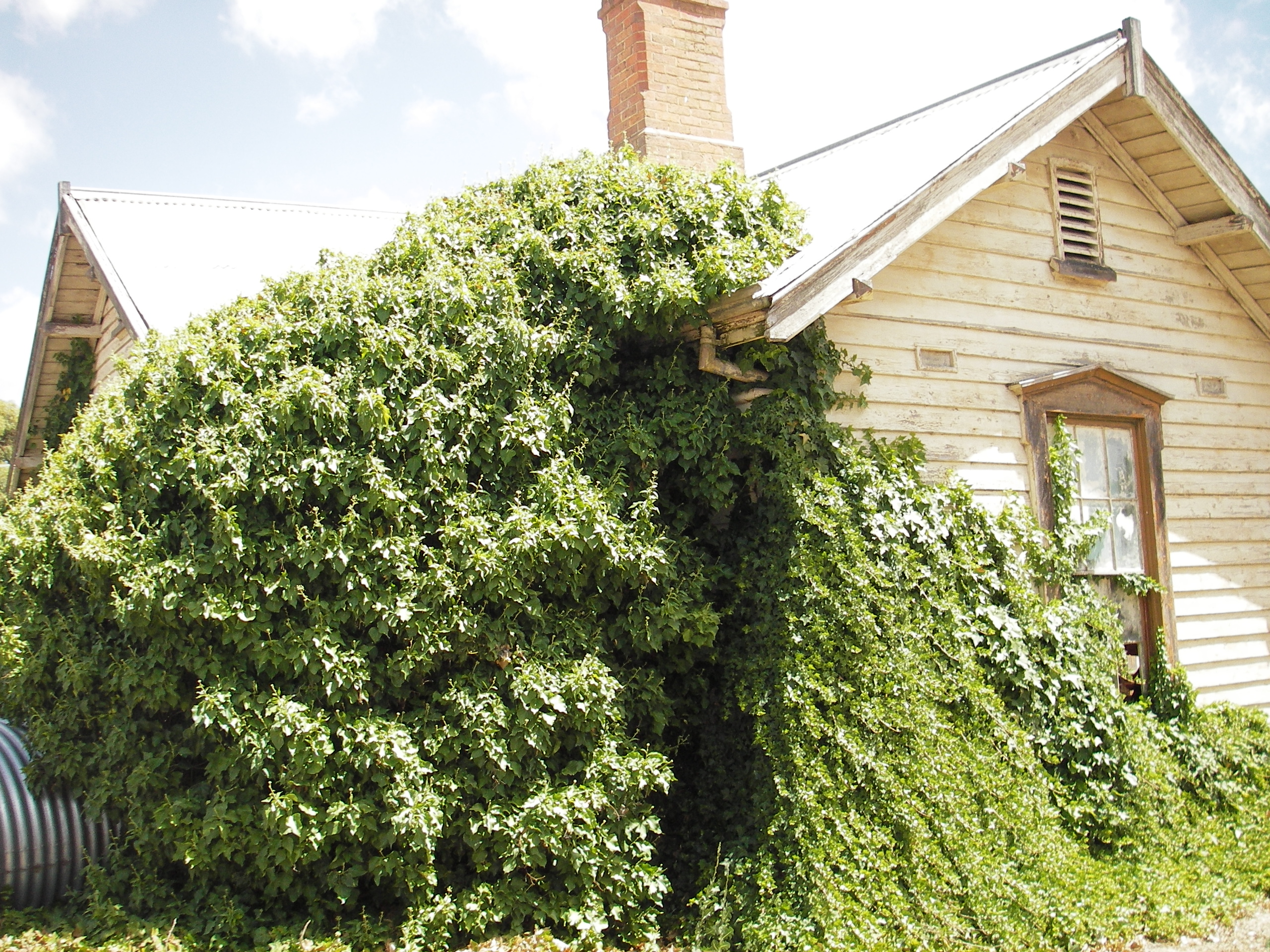
In fact the uninhabitable/dilapidated building has been tidied up from an earlier neglected state.
Side view, Jan 2008

Same view 2022, Domain
With ivy in 2008                                       Ivy removed, Domain
The 3-room building with its central chimney has been restumped & the worst of the weatherboards removed. There is still heaps of work to be done by the new owner regardless of the use they intend to make of it.
Thankfully it has been saved from possible demolition.

Friday, 3 February 2023

A world without Trove

The National Library at Canberra under suitably stormy skies (photo from Pinterest by Jared Adamo on 500px)

Remembering the last funding cuts (see Treasure Trove: why defunding Trove leaves Australia poorer) it seems that once again Trove is in the gun sights.

Without additional funds the National Library of Australia is threatening to pull the plug on Trove or reduce it to a service focused on the National Library’s collections. 

Trove (as detailed in previous posts) is the bestest resource Australia has for finding stuff, and not just for librarians and academics. There are Average Joes and Janes out there who may never visit or consider joining a library, but who access Trove regularly.

Any service (‘service’ as distinct from providing a search engine) that boasts more than 22 million visits per year is on the right track. If not for Trove delivering access & consolidation to over six Billion digital items, these items would be either not be available digitally or scattered around all the organisations that contribute to Trove.

The daunting aspect is already past – it has been created and embellished and improved over the years. Digitising more items – newspapers, photographs, ephemera… is an ongoing process that will continue to add to Trove’s importance (and a Shout Out to all the volunteers who make Trove even better by correcting text and making our search results more accurate). 

How good is Trove? Try an experiment - search Trove’s newspaper collection then, do the same for British newspapers. What, access to the British is not free! The Search results and functionality is not as easy or as clear! Thank goodness for Trove.

Want to raise the issue or help campaign - check out Speak up for Trove.


Grave work

A wonderful article from the ABC in Tasmania.
Phyllis and Peter McLennan
"Visiting ancestors at a cemetery, Peter and Phyllis McLennan were shocked to discover below the seemingly vacant patches of lawn lay dozens of unknown bodies.
Ellesmere Cemetery, in Tasmania's north-east, was full — yet, many had been laid to rest without a headstone to mark them.
Believing all should have their names recorded for posterity, the McLennans acquired a hand-drawn cemetery map — only to find 100 of the unmarked graves belonged to babies.
"That really hit us hard," Mr McLennan said. "I thought, 'surely, we can do better than that'."
The McLennans set to work laying down plaques, until every grave in the cemetery was marked.
They have now expanded into other cemeteries in the region, as well as tending to deteriorating headstones.
Part of their joy comes from tracking down living relatives.
The McClennan's efforts have been a gift to people like Aileen Johnston, whose grandmother's headstone was so worn it was unreadable.
Visiting her at nearby Stronach Cemetery, Ms Johnston was thrilled to discover the fresh lettering on a polished surface. "I was just dumbfounded, this beautiful headstone that stood out, I could read my grandmother's headstone two rows back from her grave," she said. "I thought, 'who's done that'?"
Ms Johnston was one of the few people to know where her grandfather and uncle shared a plot at Ellesmere Cemetery.
She asked the McLennans to mark the mutual grave, only for them to say "that rings a bell, I think we've done that too".
"After 180 years, my grandfather and my uncle have got a name," Ms Johnston said. "It is wonderful that I know now I can take my boys up and say, 'well, that's your great grandfather'."
The McLennans have helped update official council records along the way.
With assistance from the Dorset Tasmania History Society, they have been able to correct names and dates on headstones.
President Nigel Mercer said the council's records had been thorough, but together they had been able to significantly improve them.
He said discovering graves could be like "detective work", digging into various maps and spreadsheets to uncover what became of people.
"You feel good when you think there was a good chance we've identified where that person is buried because the records have lost track," he said.
In less than two years, they have put down more than 200 headstones, and refurbished more than 150 in the north-east.
And they plan to continue for as long as they can.
"Sadly enough, we should have started 10 years ago because we're not far away from our own plot," Mr McLennan said.
"We've probably got about another good five years' work in front of us with the surrounding cemeteries, and when we've done that, we'll put our paintbrush away and enjoy what we've done."
In recognition of their work, the McLennans were awarded the 2023 Dorset Australia Day Citizens of the Year award."

(ABC News: Bec Pridham)

Sunday, 15 January 2023

Saving TV

Article copied from ABC Wimmera's Facebook, (if you follow the link to the ABC's website you can also view the 2 short videos and reminisce)-

Treasure trove of historical Mildura footage saved in WIN TV building clear-out

A historian has saved approximately 80 per cent of the historical footage stored at Mildura's original local TV bureau from being thrown out in a clean-out of the building. Archival news footage taken of the town in the 1960s and '70s, documenting important local events such as flooding of the Murray River, has been salvaged from the former WIN TV building.

WIN TV Swan Hill

The other 20 per cent of the historical footage has been donated to other historians.

Local history enthusiast and founder of Frames of History Ian MacWilliams says he received a call from the station's staff manager Steven Menegaldo to rescue the documentation.

The establishment was occupied by Sunraysia Television 9 (STV8) in 1965, then was used by WIN News from 2006 before the station was forced to close in a statewide restructure in 2015.

"The footage goes all the way back to the STV8 days, when of course back at the start that was shot on 16-millimetre film, and eventually became tape all sorts of different type formats," Mr MacWilliams said.

"The original materials are news film, and then later on, there was news film and commercial film, which used to make the ads so all of that material has been stored at WIN TV, since it was on TV.

"That material has over time become available to me. I got hold of the 16 millimetre footage and last year in 2022 I've been able to get access to the remaining footage, which is mostly tape, all sorts of different tape."

Oftentimes, Mr MacWilliams said, videographers at STV8 and WIN News were responsible for capturing the only footage of Mildura events.

"It was then the only source of local news because the stations weren't networked," he said.

"Everything was created for local TV. It was for local consumption so when something happened in history, a news item happened in town, STV8 was sent out and they filmed it.

"Pretty much every event that we've got as a news story would never be seen again if it hadn't been rescued because it's really the only footage if it hadn't been shot by a private person, that was the only coverage of the event."

Part of a bigger picture

The Australian Centre for Moving Image (ACMI) is working with partner institution Ballarat Television 6 (BTV-6) to save their archive under a similar circumstance.

Head of collections and preservation at ACMI Melbourne Nick Richardson said regional material was a critically important part of the national screen museum's collection.

"Congratulations to [Mr MacWilliams] for going and salvaging the footage," Mr Richardson said.

"We've been instrumental in taking quite a bit of that [Ballarat's] original footage from the past six years and attempting and beginning to preserve that.

"What's really important is that there's so much content out there that no single institution can hope to preserve so having a network of organisations and interested individuals who can share that burden, I think is really important.

"And there's an opportunity for us all to share our information around technology and how best to preserve that."

Mr Richardson said the regions were under represented in ACMI's national collection.

"Our earliest item goes back to the 1890s but certainly the majority of that Australian-based footage tends to focus on the bigger centres," he said.

"So, the regional material is incredibly important. It gives us an insight into the social and economic history of those regions and I think it's a really fascinating way for emerging current and emerging generations to connect with the past and with their area.

"It's often been said that we can understand the personal look towards the future without fully understanding our past so the material is incredibly important to the country."

You learn from the past

Historian Pam Cupper grew up in Mildura and said she was delighted to hear about Mr MacWilliams' rescue project.

"I'd actually heard over the years that the material from the STV8 and WIN studios had been lost, or some of it had been lost anyway, so when I heard I was so delighted that a lot of the material seems to have been kept and hopefully now it's going to be maintained, which is such a great historical record," Ms Cupper said.

Ms Cupper said she was hopeful to see footage of inter-school debates in the 1960s recovered.

"And the [coverage of the] floods on the Murray River are really big at the moment and the marching girls were a phenomena in the late 1960s, early 1970s and I have become more interested in it from a historical point of view," she said.

"I don't have great kind of particular things that I want to want to see but I would like to see my old home as it was 50 years ago.

"It's important if you grew up there or you didn't grow up there. I'm a historian so I have a view that we can learn from the past."

By Tamara Clark ABC Mildura-Swan Hill

Hope the BTV-6 film is also saved, digitised and made available. (One of the old station identifier commercials has great video of the Wimmera's mobile library travelling to Laharum, would love to see that again).

Saturday, 7 January 2023

Locally on BorrowBox

 Local ebooks are available on BorrowBox.

The people at BorrowBox allow member libraries to add local content to their library's collection. Wimmera Libraries now have 3 locally produced ebooks on BorrowBox.

"Lost in the bush" In 1864 Isaac, Jane & Frank Duff became lost in the bush. Locals searched for the children for 9 days. This book is a day by day account of what happened on each of the 9 days, with information from contemporary articles and books.


"The fate of the Imperials"
 In 1914 the Warracknabeal Imperials decisively won the football premiership against Rupanyup. Within a month four players had joined the first local contingent to be sent off to fight in the First World War. In all fourteen of the players would enlist. This is the story of the fate of those Imperials, collected from local newspapers and their Service records.

An alphabetical listing of all the schools that have existed in the Wimmera and Southern Mallee districts. Entries include a brief history of the school, GPS coordinates and one or more photographs of the school or site.
The title comes from the fact that many of the now deserted and abandoned rural school sites are marked with trees planted by school children on Arbor Days and special occasions.
Primarily the variety of tree chosen was the sugar gum, though there are peppercorns, various cypress & pines, and ornamental deciduous trees. School gardens were also marked by large and small species of cacti & succulents, and annual bulbs - jonquils, daffodils and lilies.
Along with monumental plaques, these are often the only signs that schools have existed, and they stand as testament to the tenacity of the teachers, parents and children who attended these schools.

It is likely that more Wimmera stories may be added as local content.

Just like other ebooks in the BorrowBox collection, these books can be borrowed, so check out one today. 
Instructions for installing and using BorrowBox are available on the Library's website, if you haven't used ebooks previously.


Monday, 4 July 2022

Gymbowen Cemetery re-discovered

Congratulations to all involved in having a sign erected at the Gymbowen Cemetery. Few people today were aware of its existence, and even fewer knew where it was located.

Gymbowen Cemetery, the row of pines are on the fenceline between Allotments 90B & 90C
The Gymbowen Cemetery was established on the east side of Marsh & Lowes Rd, south of Hennesseys Rd, in the Goroke Parish, alongside its boundary with the Gymbowen Parish.


5 acres 0 roods 16 perches of Allotment 90C were reserved for a Cemetery in June 1883. 

A further Extension to the north alongside Hennessey's Road, of 3 acres 3 roods 38 perches of Allotment 90C was gazetted in July 1911. 

In 1918 10 perches were excised from the Extension to create the sweeping bend into Marsh & Lowes Rd.


The sign is more than a sign, it details the record of the only known burials at the Cemetery. These and possibly others are in unmarked graves.

The earliest record is for Annie Bertram Byrne. Annie lived for 1 day in 1883. Both the Byrne & Bertram families lived in the district. Members of both families left in the migration to the Riverina in 1900s. Denis married Lucy in 1870. Their other children were Denis born in 1871, George 1873, Michael 1875, Mary Anne 1877. Edmund Bertram 1878, Alecia Jane 1879, William Bertram 1880, James Henry 1882-1883, Evelinne Stewart 1886, Bertram Roach 1888, John Blain 1890, Lucy Emily 1893. Both Annie Bertram & James Henry died in 1883, James' death place is recorded as Harrow.

Mary Frances Mottram also died in 1883, aged 10 months. Her father George Somerset took up land at Gymbowen in 1882 & 1883, but by 1890 was declared insolvent. He stated the causes were crop failures, family sickness & the pressure of his creditors. A son Peter had lived for 1 day when they lived at Mullagh in 1874.

Hugh Knight & his mother Janet, both died in the typhoid outbreak of 1889. William Henry lost his wife Janet, son Hugh, brothers Thomas & Alfred to typhoid fever. Bill too, was admitted to hospital, but recovered. (Cemetery Trustee David Houston's son also died of typhoid in 1888).

On 26th February 1895, 14 year-old William John Lear helped milk the cows but began vomiting blood and complaining of chest pain. After he was put to bed his mother found him lying on the floor dead. The doctor diagnosed syncope due to heart disease & accelerated by vomiting.

John Norman Frederick Scott was another childhood death at Gymbowen. Both his birth & death were registered in 1913. His siblings were Leila Annie born in 1904, Alexander Henry 1905, Peter 1907. Hugh Andrew 1908, Maurice 1911.

More than most the Gymbowen Cemetery shows the hardships & tribulations faced by young families in the district.