This blog provides information, stories, links and events relating to and promoting the history of the Wimmera district.
Any additional information, via Comments, is welcomed.


Showing posts with label Anzac. Show all posts

Tuesday, 3 July 2018

Fourth of July -1918

Today, the fourth of July 2018, marks the 100th anniversary of the Battle of Hamel which was one of the most significant Australian actions of the First World War. It is well knows not only as a decisive victory, but for the contribution by Australian Lieutenant General John Monash who was commanding the Australian Corps for the first time, and it was the first occasion that United States and Australian soldiers had fought alongside one another.

Many Wimmera volunteers were amongst the more than 7,000 Allied infantry that took part (fewer than 3,000 were front-line soldiers) and were also amongst the 1,400 casualties who were either killed or wounded.
This battle was fought in and around the town of Le Hamel, (near Villers-Bretonneux & Peroone) in northern France, aiming to straighten out a bulge in the British line, and for Monash it was also an opportunity to test the tactics he believed could be used on a larger scale in future offensives.

Drawing on more than three years’ experience in wartime command, and the lessons of past successful actions by both sides, Monash devised a combined arms assault co-ordinating artillery, tanks, aircraft and infantry.


The attack was planned in intricate detail to last for 90 minutes, and the battle was a stunning success taking just 93 minutes for the Australians and Americans to achieve all their objectives. The time taken for the battle was a success in itself as many battles on the Western Front during World War One lasted much longer than planned and few achieved all the planned goals.
Along with the main action at Hamel, a diversionary attack was undertaken to the north east near the village of Ville-sur-Ancre to disguise the main attack and disrupt the ability of the Germans to counter attack.

 
Peter FitzSimons' book on the battle is available as a book or audio, while John Laffin's "The battle of Hamel"  argues that while Australian leadership was first demonstrated at Gallipoli, it came of age at Hamel.
A number of soldiers involved in the battle came from Horsham and the Wimmera. One of the volunteers who fought on this day one hundred years ago was Private Percival Roy Penglase, one of five sons of Mr Alfred Penglase of Jeparit who had enlisted and were at that time all serving in Europe.

Much of this information from the Dimboola Courier's article

Sunday, 9 October 2016

Soldiering on the land

A PROV “Soldier On” exhibition will be at Horsham Library from Monday October 17th until Friday 25th November, and then at St. Arnaud Library from Tuesday 29th November 7 until Friday 16th December.
Victoria sent about 90,000 men and women to serve overseas in the First World War, about 70,000 of whom survived to return home. As the war continued, the issue of repatriating returning soldiers became increasingly urgent. As well as providing War pensions and other financial assistance, State governments of the time set up ‘settlement’ schemes to support returning soldiers with work. These ambitious and controversial schemes involved subdividing large rural estates into smaller parcels of land for family farming blocks and leasing them back to discharged service-people. In Victoria around 11,000 farms were created. Each potential settler was required to be certified as qualified to apply, and if successful to remain in residence on that land for 5 years. In this way remote rural areas set aside for such settlement were guaranteed a population expansion for a number of years
Erecting a standard soldier settler home (SLV)
The First World War Soldier Settlement Scheme had been administered by the Lands Department and culminated with the majority of farmers walking off the land and ultimately a Royal Commission. The Soldier Settlement Commission (later called The Rural Finance Commission) began in 1945 to oversee the WW2 Soldier Settlement Scheme.
Oliver Telfer's (ex-22nd Battalion Gallipoli veteran) first house, Lascelles, 1922 (Vic. Museum)
The Public Record Office Victoria have digitised selected documents from Victorian Government files kept on returned World War One soldiers who were approved to lease a block of farming land in Victoria. These government records will help family and Australian history researchers understand the individual experience of a soldier settler, as well as the historical context of the Victorian Soldier Settlement Scheme.
An Exhibition Launch with a talk from the Exhibition Curator Kate Luciano of the Public Record Office Victoria, will take place at Horsham Library on Monday October 17th at 6.30pm. Bookings are essential via visiting the library or phoning 5382 5707.

Thursday, 19 November 2015

From Horsham to see the King

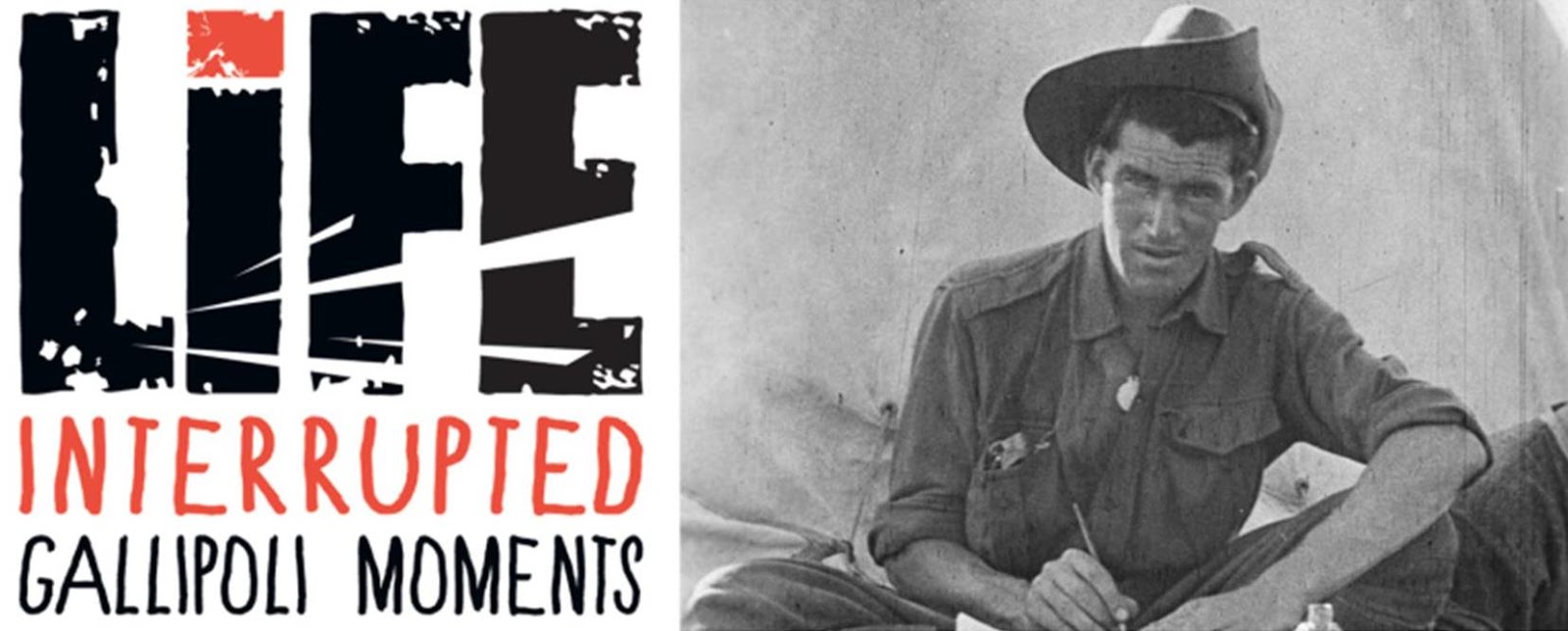
At the National Archives of Australia in Canberra, to view the “Life interrupted -Gallipoli Moments : stories of our soldiers at Gallipoli – in their own words".
The exhibition allowed you to embark on a journey with the soldiers at Gallipoli. From the excitement of enlisting, to the reality and terror of battle. Original diaries, photos and personal letters, give a glimpse of the Gallipoli campaign through the eyes, and in the words, of those who were there.
The material from the State Library of New South Wales reveals captivating personal experiences of servicemen and nurses. Service records from the National Archives remind us that everyone was a volunteer, and they came from all walks of life to serve their country. 
King's Threatre poster (NAA exhibition)
Amongst all the photos and extracts was a threate poster >> and staring out from it was the word Horsham.
One of the members of the Anzac Coves was J.Davey a baritone from Horsham, Vic.
Jack Leslie Davey was a member of the Hospital Transport Corps from May 1915 to September 1918. He embarked on 17 July 1915 on the HMAT Orsova from Melbourne. Aged 24 he had been a storekeeper, his father John lived in Baillie Street in Horsham.
The “Anzac Coves” was an Australian Pierrot entertainment troupe, consisting entirely of soldiers. Established after the Gallipoli Campaign, they performed in many places on the Western Front – in barns and sheds, often just behind the trenches.
With a lively sense of humour, the troupe satirised military life. The Coves were so popular they toured Britain in 1918.
The Coves had played in the King's, Court and Ambassadors theatres, and at Buckingham Palace before the King and Queen and the Prince of Wales.
An informal photo of the troupe in uniform (NAA exhibition)
Below is a studio group portrait photograph of the troupe taken in London, from April 1918 "'The Anzac Coves', 1st Australian Headquarters Pierrot Troupe. Direct from the firing line ‘Somewhere in France’”. This concert party was to perform from 29 April 1918 at King's Theatre, Hammersmith, with proceeds to go to the Australian Repatriation Fund for Discharged Soldiers.


Third row, left to right: unidentified; unidentified; Harry Ross (tenor); unidentified; 7461 Private (Pte) Benjamin Joseph Davies (second tenor); unidentified. Second row: 6313 Pte Frank Harold Crossley (comedian and raconteur); 4027 Driver Frank James Donovan (pianist); 1992 Lance Corporal Harold Frederick Shaw (comedian); 9619 Pte Ralph Lyn Sawyer (female impersonator and dancer); probably 9129 Staff Sergeant Rannall Carlsile (manager); A Roberts (comedian); 1955 Pte Hugh Gannon (ragtime and light comedian); 264 Sergeant Jack Leslie Davey (baritone). Front row: Fred Reade (light comedian and dancer); J Gibb (monologist); 2664 Pte Leslie Herbert Williams (bass). Also identified is W J Smith (mechanic) position unknown.
 
Biographical information on Jack Davey from "Strewth" -  Jack was a draper, who had lived all his life in Horsham, with previous military experience with the Horsham Cadets. In November 1916 Jack was sent to France and attached to the 7th Field Ambulance. In January 1917 he was detached to the Theatre Corps. He returned to Australia in May 1919. He married Mary Stoddart Fenton. Jack had an excellent singing voice and frequently performed in Australia. Jack died in Hamilton in 1970.
This photograph was part of "Our boys at the Front" series of postcards, no. 19. From a set of official photographs by special permission of the Department of Defence, proceeds from sales went to the Australian Comforts Fund. It was taken on 23 November 1917 from an unknown Australian Official Photographer, taken in Nord Pas de Calais, Nord, Steenwerck, France. It was titled - 'Anzac Coves' Concert Party in a theatre erected in a French village. Identified left to right, standing: (Pte) Reade; (Pte) Ross; (Pte) Gibb; Gunner Williams; (Sgt) Davey; (LCpl) Crossley. Sitting: (LCpl) Shaw; (Pt)e Roberts; (Sgt) Cannon; (Driver) Donovan (at the piano).

Thursday, 23 July 2015

Battling on the land

Victoria sent about 90,000 men and women to serve overseas in the First World War, about 70,000 of whom survived to return home. As the war continued, the issue of repatriating returning soldiers became increasingly urgent.  As well as providing War pensions and other financial assistance, State governments of the time set up ‘settlement’ schemes to support returning soldiers with work. These schemes involved subdividing large rural estates into smaller farming blocks and leasing them back to discharged service-people. In Victoria around 11,000 farms were created.
The Public Record Office Victoria have digitised selected documents from Victorian Government files kept on returned World War One soldiers who were approved to lease a block of farming land in Victoria. They are presented online as “Battle to farm : World War One Soldier Settlement records in Victoria”. These government records will help family and Australian history researchers understand the individual experience of a soldier settler, as well as the historical context of the Victorian Soldier Settlement Scheme.

There are also 6 "Soldiers' Stories" with photos and video, in addition to the paper files.
William & Rebecca
One of these is William Edward Bradshaw, who was born at Clarendon near Ballarat on 5th  June 1888. In his teen he worked as a telegram boy in Ballarat.
William married Rebecca Ralston on 21st April 1917. Their children were Edward, Shirley, Evelyn, Alfred, Dorothy (died at birth), William (died at 6 months), and William.
William enlisted with the Australian infantry in 1917 and fought in the battle of the Somme in France from 1917 until 1918. A qualified engineer before the war, he was recruited to work as a signaller or ‘sapper’ on the battlefields. Signallers were required to be proficient in morse-code signalling on flag, lamp and heliograph, as well as in map reading (note the flag patch on his right forearm). 
William had ambitions to be a farmer on his return to Australia and leased a soldier settler block at Wallaloo on the Avon Plains near St Arnaud in 1920. 
Things didn’t go as planned, despite working on a pretty good block he sold his lease. On a good year he harvested 930 bags of wheat and 800 bags of oats. Working two teams of eight horses left him physically incapacitated, and as a sufferer of acute neuritis by 1924 he had to abandon the land, and sell in November 1924.
The farmhouse at Wallaloo
William might have held onto the farm if he could have afforded to hire labour during his recovery. The costs and the poor timing of this farming scheme meant many farmers couldn’t make it work. The government’s large-scale purchase of land had inflated prices, which inflated the repayments on the leases soldier settlers signed. As the war ended the world-wide supply of agricultural goods and labour increased and therefore the value of the soldier’s investment in land and stock started to fall. Soldier settlers frequently became deeply in debt to stores and suppliers as well as to the government. William’s wheat, which in 1919 would have sold for 7.5 shillings, by 1929 was selling for 3.17 shillings. As the Great Depression set in, the value of all agricultural capital acquired by soldier-settlers was greatly diminished, and was often worth less than half its purchase value in 1929.
William’s story is one of thousands of cases whereby the blocks were transferred to other leaseholders due to either ill health or poor financial returns.
William died of pneumonia in Queensland on 7th August 1935.
William’s story is just one from the PROV site.
You can access the individual records of thousands of  World War One returned soldiers who leased farming land across Victoria between 1919 and 1935. Enter a settler’s name in the search box or search by geographic location through the digital map, to zoom to parts of Victoria and click on a name to access their digitised official settlement record files.
The Bradshaws on the verandah

Wednesday, 1 April 2015

Cemetery pines

A number of local Cemetery Trusts received Lone Pines this week, as part of the Anzac Centenary commemorations. They were propagated from the lone pine at the Australian War Memorial.

3 of the pines
The potted Pinus halepensis plants are a symbol of the battle which commenced on 6th August 1915, when the Australian Infantry Division launched a major offensive at Plateau 400 at Gallipoli. The ridges had been covered in the Aleppo pine (Pinus halepensis) which were cut down to cover and line trenches, leaving one solitary tree. It then became known as 'Lone Pine Ridge'. In the 3 days of fighting the A.N.Z.A.C.s lost 2,000 men and the Turkish losses were estimated at 7,000. 


Lance Corporal Benjamin Charles Smith of the 3rd Battalion sent several cones to his mother in Inverell N.S.W., Mrs McMullen sowed some of the seeds some 13 years later. Of these 2 seedlings were grown - one was presented to the town of Inverell, and the Duke of Gloucester planted the second tree at the Australian War Memorial in Canberra. 

Sergeant Keith McDowell of the 24th Battalion brought back a pine cone to give to his aunt - Mrs Emma Gray of Warrnambool. 4 seedlings were grown and planted at several Shrines of Remembrance in Victoria.
The Melbourne Shrine framed by a lone pine
In 1990, two trees were taken back to Gallipoli by veterans who attended the 75th anniversary of the Battle of Lone Pine.

Tuesday, 9 December 2014

1914-1918 news

A major project commemorating World War I has digitised 216 World War One-era Victorian community newspapers and made them available online via the National Library of Australia’s Trove portal. 


Victorians everywhere can now explore the stories of their communities and family and friends who lived and fought through the Great War.
This digitised collection contains thousands of stories waiting to be found. These newspapers of the day provide, in their original format, news and public debate; letters from soldiers, sailors and nurses; death notices, images and more.
The newspapers can be freely and easily searched by anyone at anytime and anywhere, using keywords, dates or geographical regions
The digitised newspapers cover the period 1914–19. Many soldiers were still being demobbed in 1919, and mentions of celebrations for returned soldiers can be found in papers of this time. Also, many in memoriam notices can be found in papers the year after a soldier died.

.
The collection includes Wimmera and Southern Mallee papers: Birchip Advertiser & Watchem Sentinel, Hopetoun Courier & Mallee Pioneer, Horsham Times, Nhill Free Press, Rainbow Argus, St Arnaud Mercury, Stawell News & Pleasant Creek Chronicle, Warracknabeal Herald, West Wimmera Mail & Natimuk Advertiser, and more general papers - Stock & Land, and Weekly Times.
The digitisation of these newspapers has been supported by the State Library of Victoria, National Library of Australia, Public Libraries Victoria Network, local councils and historical societies.

Monday, 21 October 2013

A Trove of papers

The National Library in Canberra have digitised a number of Wimmera newspaper editions from the First World War era.
The Sanctuary in the Shrine of Remembrance
This digitisation is part of the efforts to commemorate the Anzac centenary. The newspapers include -
  • Birchip Advertiser & Watchem Sentinel
  • Donald Times
  • Hopetoun Courier & Mallee Pioneer
  • Nhill Free Press
  • Rainbow Argus
  • Rupanyup Spectator & Lubeck, Banyena, Rich Avon & Lallat Advertiser
  • Stawell News & Pleasant Creek Chronicle
  • West Wimmera Mail & Natimuk Advertiser
The newspapers can be accessed online at the Historic Australian Newspapers page of Trove.
Trove is the National Library's free federated online search service. It focuses on providing access to its national repository of all types of Australian material.

The Library will be conducting a free introductory session for people interested in learning more about Trove and the digitised newspapers, at the Horsham Library @ 2pm on Friday 25th October. 
Bookings are essential and can be done by calling in at the library or by phoning 5382 5707.

Friday, 27 September 2013

AIF founder's resting place

A recently announced successful grant, will restore the grave of General Sir Cyril Bingham Brudenell White, KCB, KCMG, KCVO, DSO at Buangor.

The government has announced funding under the Anzac Centenary Local Grants Program which assists communities undertake Anzac Centenary projects commemorating the service and sacrifice of Australian servicemen and women in the First World War
Cyril Bingham Brudenell White was born September 23 1876 in St Arnaud and grew up on pastoral stations in Queensland. He went to school in Brisbane and at sixteen he started work as a clerk at the Australian Joint Stock Bank in Brisbane.
In 1897 he was a commissioned as an officer in the Royal Australian Artillery and during the Boer War went to South Africa with the Australian Commonwealth Light Horse in 1902. In 1905 he married Ethel Davidson and attended the British Army Staff College in England.
He returned to Australia in early 1908 and at the outbreak of WWI was appointed Lieutenant Colonel and Chief of Staff of the 1st Australian Division, AIF.
Lieutenant Colonel White landed at Gallipoli on April 25 1915. In October 1915 he was given the task of planning the withdrawal of the ANZAC forces from Gallipoli. It was White's organisational skills that saw the withdrawal was conducted without loss. Read more in The silence ruse : escape fromGallipoli ; a record and memories of the life of General Sir Brudenell White’ byRosemary Derham.

From March 1916 until May 1918 he continued as a staff officer under General Birdwood in France and Belgium and was widely regarded as the man who truly ran the AIF. In May 1918, when General Birdwood was promoted to command the British Fifth Army, White accompanied Birdwood as his Chief of Staff, and Monash was appointed to command the Australian division (General Haig had suggested White should be given the command, but he declined).
After the armistice in November 1918, White was appointed to preside over the Demobilisation and Repatriation Branch in London. He was first knighted in 1919, and returned to Australia in 1920 and was appointed Chief of the General Staff.
He retired from military service in 1923 and took up the positions with the Commonwealth Public Board, then with the New Zealand Loan and Mercantile Agency.
He purchased ‘Woodnaggerak’ at Middle Creek followed by ‘Challicum’ near Buangor.
In March 1940, White was recalled to active duty as a full general and reappointed as Chief of the General Staff .
Insiginia recovered from the crash
In one of the worst air crashes in Australia, on August 13 1940, General White was flying in an Australian Air Force aircraft from Melbourne when the aircraft crashed as it approached the aerodrome at Canberra, killing White and 9 others on board instantly. Others killed included Brigadier Geoffrey Austin Street, Minister for the Army, and Member for Corangamite, James Fairbairn, Minister for Air and Civil Aviation, and Member for Flinders, and Sir Henry Gullett, Vice-President of the Executive Council. The story of the crash and its effect on the Australian government is in Air disaster - Canberra : the plane crash that destroyed a government’ by AndrewTink.
 
The funeral procession down St Kilda Rd
His funeral was held at St Paul’s Cathedral in Melbourne, then returned soldiers from the Ararat and Beaufort areas preceded the hearse and a cortege of about 150 cars when he was buried in the Buangor Cemetery.His wife Ethel was buried there in 1975.


Tuesday, 23 July 2013

Trees in remembrance

In Australia, commemorative trees have been planted in public spaces since the late nineteenth century. Arbor Days were held regularly in most Victorian State Schools during the late 1800s and early 1900s, and numerous trees were planted in parks in Melbourne and throughout Victoria to mark the visits of important and famous people.
This tradition of commemorative planting was continued in 1901 when at the end of the Boer War trees were often planted for each soldier of the district who was killed in South Africa. These plantings, however, rarely consisted of more than two or three trees in each town.
During and after the First World War venues of honour consisting of trees lining significant streets became a popular form of commemoration. They represented a new egalitarian approach to the commemoration of soldiers where rank was not a consideration: each tree symbolises a person.
Booroopki “towering evergreens would stand aloft in their dignity”
Booroopki's memorial
Avenues of honour are a uniquely Australian phenomenon. Australians, and in particular Victorians, embraced the idea of planting them more enthusiastically than any other country in the world. The Eurack Avenue of Honour (near Cressy) is the earliest known avenue of honour to be planted in Victoria and dates from 1916.
By the time of the Second World War avenues of honour had declined in popularity as a means of commemoration. Today it is estimated that over 300 avenues of honour have been planted in Victoria to commemorate service personnel since 1901.
The Avenues of Honour 1915-2015 Project is a national initiative which aims to commemorate the memory of every individual who has fallen in the service of Australia with a tree.
 

With community support, the project will document, preserve and reinstate the original Avenues of Honour where possible, and establish new Avenues of Honour by the centenary of Anzac in 2015. More than 102,000 Australians have died in the service of their country during various conflicts.
The first stage of the project is capturing information about existing and lost Avenues of Honour and the people commemorated by them. 
TreeNet's home-page
TREENET, a national not-for-profit organisation based in Adelaide, has established a database of all known avenues and is collecting other information to build a comprehensive national record. 

The wayside stop at the Booroopki Avenue
Local Avenues include:
TheBooroopki Avenue of Honour was planted with thirty-five Eucalyptus and Pine trees in memory of those who fought in the First World War. The Avenue was opened on 29th August 1918 at a ceremony that began with the national anthem and featured an address by Mr C.D. Block. Three trees were given prominence as those dedicated to three deceased servicemen: Pte. J.R. Gardner, C.F. Patching and P. Brennan. It is great that such a small community like Booroopki has a wonderful ongoing relationship with their war memorial. Services are still held there on Anzac Day, and Daryl Crabtree & Daryl Povey have compiled a short family history on each soldier at Booroopki World War I
The Dimboola Avenue of Honour, along Ellerman and Muller Streets, was planted in 1949 to commemorate the First and Second World Wars. The avenue comprises of Sugar Gum trees (Eucalyptus cladocalyx) and Southern Mahogany trees (Eucalyptus botryoides). The Dimboola Memorial High School is also in Ellerman Street.
The Donald Avenue of Honour known as the Memorial Crescent, was planted in 1995 to commemorate the Second World War. The Crescent was planted with eighteen sugar gum trees planted in a double row along Byrne Street . Under each tree was a white wooden cross with the name of a local servicemen. The Crescent was an Australia Remembers project for the 50th Anniversary of the end of the Second World War.

Great Western's avenue on the Western Highway
The Great Western Avenue of Honour was planted in 1935 to commemorate the First World War. It is located on the Western Highway between Stawell and Ararat. The avenue is comprised of Desert Ash trees (Fraxinus angustifolia) and Plane trees (Platanus).
The Hopetoun Avenue of Honour, along Warracknabeal Road south of the town, comprised 70 Sugar Gums planted to commemorate the First World War. Today there are only a few gums remaining.
Roberts Avenue, Horsham
The Horsham Boer War Avenue of Honour was planted in 1902 to commemorate the Boer War. It was originally planted with 80 English Oak trees (Quercus robur) along Roberts Avenue, between Darlot and McPherson Streets. Now only the section between Urquhart and McPherson Streets remains. A plaque on Roberts Avenue records the dedication in 1902.
Information on war memorials in Victoria is in the Victorian War Heritage Inventory
 

Wednesday, 26 June 2013

Blackboards to battlefields

It is great to see that local groups are applying for grants from the government's Anzac Centenary Program to commemorate the 100 year anniversary of Australia's involvement in the First World War (see my post of 8 June 2012).
The Warracknabeal Historical Society is looking to locate all the Honour Boards from local schools and collate all their information into a database. A seriously involved operation when you realise that most of the local rural schools no longer exist and it will be a detective job to research who may have inherited the boards (and shudder with the thought that some may no longer exist).

On the subject of school honour boards and teachers & ex-students serving in World War I is a new book - 'Our schools and the war' by Rosalie Triolo.

The Great War profoundly touched the lives of Australian teachers, school children and local communities, and with lasting consequences. Every teacher had the task of explaining the war to their students. Many teachers, a disproportionately large number, fought and died, and were joined by their older students. For years after, the names of those who fell were respectfully displayed on school honor boards, in honor books and remembered by other commemorative means, including through the introduction of Anzac Day. 
How teachers and school communities were affected by patriotic appeals and activities, and how they responded to the long years of grim news from Gallipoli, the Western Front and other sites of training, fighting and convalescence, is revealed in an account that historians, general readers and today’s students will find illuminating and deeply moving. 
Many of the contributions to the book come from Norman Heathcote a school teacher who joined up  in July 1915, when he was 28, and wrote about his experiences and about teachers, trainees and pupils he knew on active service from schools where he'd taught. He was a quartermaster during the war, he sailed with fellow teacher-soldier Lance-Corporal Henry Pender of Dadswells Bridge. After the war he became a School Inspector in 1924. He was the President of the Nhill RSL in 1921.

A wonderfully fascinating account from the book concerns a Ni Ni East teacher who arranged for a pair of socks to be knitted for General W.R. Birdwood (he was the commander of the Australian forces at Gallipoli), and as a fund-raiser, a charge was made for the privilege of knitting a row. The General replied that it "is really wonderful that your school, with only 10 pupils, has been able to build up a fund of 50 pounds".
If you know the location of a school honour board, the Society would love to hear from you.

Friday, 8 June 2012

ANZAC Centenary


Between 2014 and 2018 Australia will commemorate the Anzac Centenary, marking 100 years since our involvement in the First World War. It will mark 100 years since the Gallipoli landings and major Western Front battles.  It will also recognise other significant military anniversaries throughout the last century.
The Anzac Centenary provides us with an opportunity to remember those who have fought and served in all wars, conflicts and peace operations in the past hundred years and especially remember the more than 100,000 who have given their lives in service.

 
The Australian Government will be providing $83.5 million over seven years to implement the Anzac Centenary Program 2014 – 2018.
There will be a package of commemorative events and initiatives is based on the recommendations of the National Commission and the Anzac Centenary Advisory Board.

Key elements of the program include:
  • the refurbishment of the First World War galleries at the Australian War Memorial
  • the refurbishment and maintenance of war graves in Australia and overseas
  • funding for the running of commemorative services overseas during the Centenary;
  • a local grants program to help communities carry out their own Anzac Centenary commemoration projects, with funding available from January 2013
  • an Arts and Culture Fund to support individuals, artists and cultural institutions to develop commemorative displays and artistic creations showcasing our military history
  • a multimedia education program, travelling exhibition or similar, that has broad community reach to help Australians learn more about our military history
  • funding for the establishment of the Anzac Interpretive Centre at Albany in Western Australia, the departure point for many convoys

 If you wish to be involved in a local grants program to encourage community commemoration projects, check out the website for the Anzac Centenary - http://www.anzaccentenary.gov.au/


Friday, 22 April 2011

Gallipoli on foot

Walking the Gallipoli Peninsula : making the most of your visit to the battlefields by Tony Wright.Tony Wright first travelled to Gallipoli with Australian Prime Minister John Howard in 2000. He found himself intrigued by the swelling crowds of mainly young people making the pilgrimage to Anzac Cove. He returned again and again over the decade, shouldering a backpack containing his great-uncle's Gallipoli diary. Along the way he fell in love with Istanbul and the nation of Turkey. He has learned the secrets of both Istabul and the Gallipoli region, and explored underground Cappadocia, while meeting many colourful and memorable characters on his journey.
This book is different from the battlefield guides, it is a travel adventure to inspire you to shoulder your backpack, hop on a flight and follow Tony Wright's footsteps through Turkey and the Gallipoli Peninsula.
If you do want a battlefield guide, you can't go wrong with local authors Pam Cupper & Phil Taylor's "Gallipoli : a battlefield guide".