This blog provides information, stories, links and events relating to and promoting the history of the Wimmera district.
Any additional information, via Comments, is welcomed.


Thursday, 23 August 2012

Ned's burial wish

The Victorian Government recently announced that the remains of the bushranger Ned Kelly will be released to members of his family for burial.

This decision is in accordance with Kelly’s wishes which was recorded in a letter held in the PROV Collection (PROV holds the world’s largest accumulation of original records related to the Kelly Gang).
The letter, dated 10 November 1880, is held along with other letters Kelly wrote via dictation whilst in jail awaiting execution. Kelly was unable to write any of the letters himself owing to the injuries he had received at the Glenrowan Siege, and so signed them with his mark - an ‘X’. The letter is part of PROVs online Kelly Historical Collection, which are in turn effectively pages within the Kelly Capital Case file.
This file was created at the time by the Crown Law Department to document the process that occurred after his trial to determine whether a recommendation should be put to the Governor as to whether the mandatory death sentence should be commuted to a lesser one. (This was the case for all prisoners sentenced to death for capital offences).
Kelly was executed by hanging at the Old Melbourne Gaol 11th November 1880, and buried there.
Old Melbourne Gaol
 Following the closure of the Old Melbourne Gaol,in 1929 work was undertaken to allow extensions to the Working Men’s College (now RMIT) in the former prison yard (the initials of each executed inmate and the date of his or her execution were carved into the wall adjacent to the burial plot, some of these bluestone blocks are now in the Beaumaris breakwater). The remains of all executed inmates (approximately 30 individuals) that could be located were exhumed, transferred to Pentridge Prison, and re-interred in mass graves. In 1937, four additional coffins were unearthed in a different area, and taken to Pentridge for reburial.
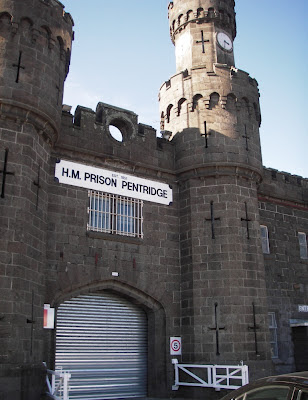
The initial process of exhumation, re-internment was disorganised and over time the actual grave sites became confused, and after Pentridge closed and redeveloped into a housing estate, workers uncovered a mass graves site. Heritage Victoria were called in to investigate and identify the burial locations of the Old Melbourne Gaol  inmates, and also those of the ten executed Pentridge prisoners. In 2008-09 they discovered the individual plots of the Pentridge prisoners, and 3 mass graves of the Old Melbourne Gaol inmates.

Forensic profiling and analysis was undertakrn to identify the remains. This work identified one of the skeletons as Ned Kelly's, which his family descendants will re-bury in Kelly Country.


Thursday, 16 August 2012

Changing traffic

A piece of Horsham and library history has disappeared with the removal of the Lions Club's Traffic School, which stood at the corner of Park Drive and Natimuk Road for many years.
Generations of children have learnt their road rules by cycling around its mini-streets.
In the past the Wimmera Regional Library Service ran Traffic Schools as part of their Childrens Holiday Activity Program (CHAPs). It was a fun activity for the kids, and for the staff manning the signal controls as well.
Childrens Librarian Michael Hogan directing traffic in the early 80s
The small triangular recreation reserve owned by the Horsham Rural City is currently under development, as the Council employs Millers Contractors to realign Park Drive, to off-set the road intersection with Gardenia Street. HRCC will be constructing a carpark between this road and the Skate Park to provide all-day parking spaces.
This work is occurring at the same time as construction begins at the allotment next door on the new Target shopping development, though work may slow down in the current wet conditions.

Saturday, 4 August 2012

The oil on Antwerp


The Library was fortunate recently to have donated, a copy of One of nature's wonderlands : the Victorian Grampians by James W.C. Audas. It was published in 1925 in Melbourne, and is a natural history,concentrating on the flora of the different regions of the Grampians.
'Turret Falls' plate from the book

James Wales Clarendon Audas (1872-1959) was a member of the staff of the National Herbarium of Victoria. His visits to the Grampians made a particular impression on him. He recorded its plant life and brought together his investigations in One of Nature's Wonderlands. During his career Audas was a prolific writer; recounting tales of his botanical wanderings all around the state over half a century.

An interesting aspect of the book was a number of advertisements in the back of the book, including one for Bosisto's Parrot brand eucalyptus oil.
Joseph Bosisto was born on 21 March 1824 in Leads, England. He left school in 1839 and was apprenticed to a druggist. Engaged by F.H. Faulding, he sailed to Adelaide in June 1848. In 1852 he married Eliza Johnston, they settled at Richmond, Victoria, where in a renovated hotel stable he had a prosperous pharmacy and was consulted as 'Doctor' Bosisto.
Keenly interested in the eucalyptus plant and its multi-faceted uses, Bosisto with the encouragement of Ferdinand Von Mueller, the Government Botanist, began to explore eucalyptus oil on a commercial basis. He set up a small eucalyptus oil distillation plant near Dandenong Creek in1852. Bosisto was probably first to make distil eucalyptus oil commercially and to win repute for manufacturing Australia's first 'original' product. His decoctions of eucalyptus oil used in a variety of medicinal products were to make him a household name. The parrot sitting on the eucalyptus branch, inside the yellow circle was his most famous trademark.
James Bosisto
Bosisto was a founder of the Pharmaceutical Society of Victoria in 1857, its president and co-editor of its Journal. He helped establish the College of Pharmacy. He served for 12 years on the Richmond Municipal Council and was mayor in 1865-67. He represented Richmond in the Victorian Legislative Assembly in 1874.
Bosisto lost heavily in the building society crashes and spent his last years in straitened circumstances. He died aged 74 in Richmond on 8 November 1898. He was predeceased by his wife, they had no children. Bosisto formed the Eucalyptus Mallee Oil Company with five other notable citizens. They purchased the Antwerp Station freehold and erected buildings for the distilling equipment. It commenced extracting oil on 24 May 1882. Another large lease of land was added in July 1884. It employed about 70 men, however it was difficult to maintain a sufficient work-force. EMU brand was distilled at the Bosisto & Co Antwerp distillery and Parrot brand at Dandenong or Emerald.

Bosisto was interested in local community affairs. It was through the gradual land settlement and employment at the distillery, that his untiring efforts gained the Antwerp district a Methodist church built on land he donated, he was the patron of the Antwerp Cricket Club. In 1887 he wrote to the Education Department requesting the establishment of a State School.
From 1900 onwards the distillery output began to wane, and in 1904-05, the Antwerp plant was moved to new sites in N.S.W. Surplus stock was disposed of, and later a section of land was sub-divided and sold by auction. Many employees received grants of land and the Antwerp township began to take shape.

Tuesday, 31 July 2012

West of civilization

Hopetoun West Baptist Church sign
The Hopetoun West Baptist Church operated from 1906 until it was closed in 1965. Between 1933 and 1954 the Karkarooc Shire's population fell by 35%, due to farm mechanisation and the drift to larger towns, the droughts in the 40s and 50s. To say nothing of mouse & locust plagues, sand-drift, drought or farm income fluctuations.
The Church & its monument
This left the hopes and dreams of the church founders empty and abandoned. Fortunately for us today they built to last, and the remains of their stone buildings still stand today, abet somewhat shakily. The floor is a little treacherous, and sections of the roof have fallen in, but you still get the impression of what the church was like.
The interior with its pressed tin ceiling
The lead-light window panes have been destroyed

Likewise the Hopetoun West State School No. 3321. It opened in August-November 1898 in a hall with a porch built of pine plastered with lime and later an iron shelter shed.

.
The school entrance to the school
 A new hall, built with local labour, was occupied in 1913. The Hopetoun West school closed in May 1947 due to falling attendance.
In this marginal land, schools opened and closed with remarkable frequency, with buildings moving from one site to another following the population flows. Of the 378 schools established in the Mallee region, only 100 remained open by the 1970s, and they have dipped even further since. 
Despite being unused for more then 50 years the building stands as testament to the efforts of the local families who erected it.

The interior with its fireplace and tongue & groove board ceiling

Tuesday, 17 July 2012

Locally for kids

It is not often that books are produced for children about the local area, but Bob Heddle has written three on the Mallee.
The trilogy about Zac and Ria and the Valemink family - 'The monster tower and the Gannawarra Goppo', 'The mischievous witch of Wychitella' and 'Chinkapook and the Manangatang mountain munyips' all take place in the Gannawarra area in the northern Mallee, where some of the strangest and wildest things in the world happen.
The books are aimed at the primary school 8+ age range, with a number of black-&-white and water-colour illustrations (also by Bob Heddle) scattered through the text.

Sunday, 15 July 2012

Football 1912-2012

Recently the anniversary reunion was held for the descendants of Edenhope's 1912 football premiers.
In those early days players had no Saturday half-holiday and they had to beg the day off to compete. They rode wagons, bikes and horses to travel to matches, and when reaching the ground used to change behind trees as there were no dressing sheds.
The 1912 Grand Final was according to the press "the best game of football witnessed on the local ground for the season". The match was between Edenhope and Salt Lakes (Douglas). The final scores were - Edenhope 5 goals 13 behinds (43 points) to Salt Lakes 1 goal 12 behinds (18 points).
This was Edenhope's first ever premiership, they had had a team as far back as 1908. The presentation medals were awarded at a celebration at the Mechanics Institute in December. The president Mr S.H. Ramsden told how the football has been up to a high standard, the umpires satisfactory, and a creditable performance. He also said that while thanking those who were responsible for their success, they must not forget that indespensible portion - the barrackers.
Edenhope went on to win the 1913 and 1914 premierships, and after World War I the 1919 cup.
This year may also be Edenhope's premiership year too, as they are undefeated this season.
Back row: Jim Burns, Herbert Wynniat, Martin Cranage, Bill Burns, Bill Whittingham.
3rd row: Tom Robertson, Jack Ryan, Leo Kelly, Sam Burns, Henry Burns, Bert Robertson, Jim Robertson.
2nd row: Bill Bird, H.C. Carstairs, Charlie Whittingham, Jack Norris, Arthor Bird, Jack Marr.
Front row: Martin Ryan, Jack McDougall, Don Caldow (umpire), Alf Bird, Angus McDonald.

Friday, 8 June 2012

ANZAC Centenary


Between 2014 and 2018 Australia will commemorate the Anzac Centenary, marking 100 years since our involvement in the First World War. It will mark 100 years since the Gallipoli landings and major Western Front battles.  It will also recognise other significant military anniversaries throughout the last century.
The Anzac Centenary provides us with an opportunity to remember those who have fought and served in all wars, conflicts and peace operations in the past hundred years and especially remember the more than 100,000 who have given their lives in service.

 
The Australian Government will be providing $83.5 million over seven years to implement the Anzac Centenary Program 2014 – 2018.
There will be a package of commemorative events and initiatives is based on the recommendations of the National Commission and the Anzac Centenary Advisory Board.

Key elements of the program include:
  • the refurbishment of the First World War galleries at the Australian War Memorial
  • the refurbishment and maintenance of war graves in Australia and overseas
  • funding for the running of commemorative services overseas during the Centenary;
  • a local grants program to help communities carry out their own Anzac Centenary commemoration projects, with funding available from January 2013
  • an Arts and Culture Fund to support individuals, artists and cultural institutions to develop commemorative displays and artistic creations showcasing our military history
  • a multimedia education program, travelling exhibition or similar, that has broad community reach to help Australians learn more about our military history
  • funding for the establishment of the Anzac Interpretive Centre at Albany in Western Australia, the departure point for many convoys

 If you wish to be involved in a local grants program to encourage community commemoration projects, check out the website for the Anzac Centenary - http://www.anzaccentenary.gov.au/


Thursday, 24 May 2012

Longerenong in print

The book "Longerenong Homestead : 150 years and beyond : 1862-2012" was launched in Murtoa with an exhibition of art and photography by Susan Devlin.

The foundation stone
In 1844, the land was first settled by Dugald McPherson and William Taylor, and in 1848 subdivided into Ashens (McPherson) and Longerenong (Taylor), then in 1856 it was leased to the Wilson brothers (Alexander, Charles, John & Samuel) who had been in occupation. Various Wilsons held the property until 1874 when the licence was transferred to Austin & Bullivant. The pastoral licence was cancelled in 1884. Other families with long associations with Longerenong were the Delahuntys who bought the estate in 1924, it was then purchased by the Gregorys in 1920 who held it until 2002. Longerenong is currently owned by Donna Bourke and Ian Pausacker.

The stained glass above the staircase

It was Samuel Wilson who had the grand homestead built in 1862. There is Australian cedar throughout, a slate roof, marble floor tiles and fireplaces. The grand divided staircase of carved cedar is surmounted by a  stained glass skylight which has a coat of arms with the kangaroo and emu back-to-back.

The book covers both the Longernong homestead and pastoral run, as well as the township of Longerenong. It contains a variety of information about the homestead from the floor plan and diary excerpts, to flood & drought, and entries from Davey's Longerenong Store book. It is interesting to see photographs of the history of changes to homestead through the years (the earliest is from 1863).

Thursday, 10 May 2012

Horsham Heritage

Alleyway with the ubiquitous supermarket trolley
Twenty-one walkers and three guides tramped up and down the lanes of Horsham on the weekend. Locals and visitors, from as far away as Gippsland, heard stories of Horsham's history - the buildings those still standing and those demolished, and the historic record of the drains sewers and gutters.
They ventured up paved alleyways no-one realised existed - the Hidden Horsham. They heard stories of the characters and personalities who have populated and influenced the development of the facilities and utilities.
The Twilight Laneways Walk was part of the Wimmera National Trust's Heritage Festival.