With such a large ancestry from the Emerald Isle, researching your Irish family heritage is part of many a family history.
The Genealogical Society of Victoria are conducting "Beginning your Irish family history"
The presenters are Maureen Doyle and Beryl O'Gorman.
Topic covered will include BDMs,census & other substitutes, and land records.
The session is on Thursday 15th August from 10:30am to 1:00pm, at Level 6, Queen St in Melbourne.
Costs for GSV members: $30, RHSV/CAV/FHC members: $45, Non-members: $60.
Books are essential. Contacts Phone: 9662 4455 Email: gsv@gsv.org.au Website: www.gsv.org.au
This blog provides information, stories, links and events relating to and promoting the history of the Wimmera district.
Any additional information, via Comments, is welcomed.
Tuesday, 16 July 2019
Wednesday, 26 June 2019
B.D.Ms
Records of births, marriages and deaths can provide unique insight into your family history and identity.
Effective 1 July 2018, the Victorian Registry of Births, Deaths & Marriages will reduce the price of their historical images from $33.00 to $24.50.
The historical index holds these life events registered in Victoria.
An 'Uncertified historical certificate' is a scanned image of the original, often handwritten, record that you can download.Great for family history purposes, but if you require a Certificate for official purposes you'll need a physical printed certificate that the Registry mail out to you.
The historical index holds these life events registered in Victoria.
| Life event | From | To |
|---|---|---|
| Births | 1853 | 100 years before today's date |
| Marriages and relationships | 1853 | 60 years before today's date |
| Deaths | 1853 | 30 years before today's date |
| Church baptisms, marriages and burials | 1836 | 1853 |
An 'Uncertified historical certificate' is a scanned image of the original, often handwritten, record that you can download.Great for family history purposes, but if you require a Certificate for official purposes you'll need a physical printed certificate that the Registry mail out to you.
Monday, 8 April 2019
Cataloguing for collections
Always wanted to be a cataloguer, but didn't know how?
Have a historic collection, but no idea on how to organise it?
Then the 'Victorian Collections Cataloguing Workshop' is aimed at you.
This hands-on workshop provides an introduction to the principles of digitisation and collection management. Participants will learn how to catalogue collection items using the free, online and custom-built Victorian Collections cataloguing system.
Check out the Victorian Collections website to see what has already been added to their catalogue, and some of the stories they have collected.
Victorian Collections workshops offer a relaxed and open environment and cater for participants with any degree of museum and computer literacy, as well as ongoing cataloguing support for community museums, and small and medium collections.
Date: Wednesday 8th May 2019.
Time: 10am to 3:00pm.
Venue: Horsham Library, Mibus Centre, 28 McLachlan Street, Horsham
Cost: Members $10.00 Non-members $20.00
Further information contact: 1800 680 082 (Australian Museums & Galleries Assoc.)
Have a historic collection, but no idea on how to organise it?
Then the 'Victorian Collections Cataloguing Workshop' is aimed at you.
This hands-on workshop provides an introduction to the principles of digitisation and collection management. Participants will learn how to catalogue collection items using the free, online and custom-built Victorian Collections cataloguing system.
Check out the Victorian Collections website to see what has already been added to their catalogue, and some of the stories they have collected.
Victorian Collections workshops offer a relaxed and open environment and cater for participants with any degree of museum and computer literacy, as well as ongoing cataloguing support for community museums, and small and medium collections.
Date: Wednesday 8th May 2019.
Time: 10am to 3:00pm.
Venue: Horsham Library, Mibus Centre, 28 McLachlan Street, Horsham
Cost: Members $10.00 Non-members $20.00
Further information contact: 1800 680 082 (Australian Museums & Galleries Assoc.)
Saturday, 6 April 2019
Stick Shed by drone
Some great video of the Stick Shed by the ABC Western Victoria crew.
Originally it only re-opened for the Murtoa Big Weekend in October each year, then once a month, now it is open 6 days per week!
Tourists are coupling the Stick Shed with the Silo Art Trail.
Opening times are: Tuesday-Saturday 10am to 12:30pm and Sunday 10am to 2pm.
(Video from ABC Western Victoria's Facebook page)
The Murtoa Stick Shed is a National Heritage listed building (Australia's 101st),
constructed in the 1940’s to store grain. It is now in high demand by tourists who want to see this iconic building.Originally it only re-opened for the Murtoa Big Weekend in October each year, then once a month, now it is open 6 days per week!
Tourists are coupling the Stick Shed with the Silo Art Trail.
Opening times are: Tuesday-Saturday 10am to 12:30pm and Sunday 10am to 2pm.
Wednesday, 13 February 2019
Is The Dry on?
There has been more speculation, informed speculation, that the film version of the novel 'The Dry' by Jane Harper will be filmed in the Wimmera.
In December news reports stated that Eric Bana had been in the district scouting for locations.
Movie star Eric Bana dropped into Minyip today for an ice cream and the latest Minyip Show & Shine calendar (from ABC Western Victoria's Facebook page, 7th December)
"Filmmakes have selected the town's (Minyip) iconic Club Hotel - which featured heavily in 'The Flying Doctors' - as a shooting location...of a film adaptation of author Jane Harper's novel 'The Dry'" (The Weekly Advertiser newspaper 19 December 2018).
Eric Bana is an executive producer for the project, his first role in an Australian film since 2007 with the release of 'Romulus, my father' another book to film drama.
Roll forward to February, and last weekend a casting call went out to Beulah and Minyip for extras for the shooting of "a major film".
The producers did not specify the name of the film, and the media spokespeople for 'The Dry' have refused to divulge filming locations, but as the casting people required 60-70 people for a funeral scene, and as a funeral sets up the story for 'The Dry' it is reasonable to guess there aren't two funeral films in the offing.
The understanding is the film will be shot around Minyip, Hopetoun, Beulah & Warracknabeal, another tourism boost for Yarriambiack Shire adding to the Silo Art Trail.
In December news reports stated that Eric Bana had been in the district scouting for locations.
Movie star Eric Bana dropped into Minyip today for an ice cream and the latest Minyip Show & Shine calendar (from ABC Western Victoria's Facebook page, 7th December)
"Filmmakes have selected the town's (Minyip) iconic Club Hotel - which featured heavily in 'The Flying Doctors' - as a shooting location...of a film adaptation of author Jane Harper's novel 'The Dry'" (The Weekly Advertiser newspaper 19 December 2018).
Eric Bana is an executive producer for the project, his first role in an Australian film since 2007 with the release of 'Romulus, my father' another book to film drama.
Roll forward to February, and last weekend a casting call went out to Beulah and Minyip for extras for the shooting of "a major film".
The producers did not specify the name of the film, and the media spokespeople for 'The Dry' have refused to divulge filming locations, but as the casting people required 60-70 people for a funeral scene, and as a funeral sets up the story for 'The Dry' it is reasonable to guess there aren't two funeral films in the offing.
The understanding is the film will be shot around Minyip, Hopetoun, Beulah & Warracknabeal, another tourism boost for Yarriambiack Shire adding to the Silo Art Trail.
Postscript: Yes it happened - check out some of the real locations from the film in this later post "Describing the Dry"
Monday, 12 November 2018
The battle is over - live
The Horsham City Pipe Band and part of their rendition of the "Battle's o'ver", performed at the cenotaph beside the Wimmera River, a distinct Australian setting to a Scottish air.
Performed as part of the international simultaneous tribute for the Centenary of the Armistice of World War One.
Thursday, 8 November 2018
The battle is over
Throughout the United Kingdom, the sound of over 2,000 bagpipes will fill the air before dawn has broken on 11th November 2018. In cities and towns throughout the land, individual pipers will play "Battle’s O’er” - a traditional air played by pipers after a battle. Heralding the start of the day’s commemorations, they will play the haunting tune outside churches and cathedrals, in market squares and muddy fields, on hilltops and high streets, in valleys and village greens throughout the country, and at scores of locations overseas, including Australia.
A lone piper will play "Battle’s O’er" alongside the Grave of the Unknown Warrior, Westminster Abbey, London, with others undertaking a
similar performance at 6am local times at individual locations all over the world, starting in New Zealand. In Australia that is at 5pm on the 11th. They will mark the exact time the Armistice was signed.
Hundreds of pipers - massed bands and solo pipers - across Australia are preparing for their role in the international commemoration. Special massed bands will assemble at the Shrine of Remembrance Melbourne, Adelaide War Memorial, King’s Park Perth and on Macquarie Wharf Hobart while bands and solo pipers take their place at memorials in suburbs and rural and regional communities. In Horsham a solo piper will play at the cenotaph at 5pm.
The “Battle’s O’er” was written at the end of World War One, and adopted as a tribute to more than 2000 British and Commonwealth pipers who lost their lives in battle during the war.
A poignant tribute to the soldiers killed and wounded in World War One by more than 1000 pipers and drummers from Australian pipe bands on the Centenary of the Armistice.
Tuesday, 6 November 2018
Big Lizzie
The State Library of Victoria is always adding to their collection, and have just highlighted the release of the images of amateur photographer Wilf Henty, who worked for the Victorian Railways and took photographs documenting life from 1901 through to 1940.
Wilf Henty, a collateral descendant of the Henty family who took up residence in the Portland district of Victoria in 1829. Wilf worked for the Victorian Railways, and his photographic work documents the life and interests ranging from Manangatang in the Mallee to the tall forests of East Gippsland around Bruthen.
The two images here, are of Big Lizzie, and would have been taken between 1920 and 1924 when she was in the Mallee.
![]() |
| Big Lizzie with a man standing between the engine and trailer |
Big Lizzie was built by Frank Bottrill, in Richmond, in 1915, with a 60hp Blackstone water-cooled crude oil engine and fitted with Bottrill's Dreadnought wheel, patented in 1906. Lizzie worked in the Mallee clearing fruit blocks, and traveled down through the Wimmera to Glendinning near Balmoral in 1924.
![]() |
| Big Lizzie's trailer with 2 stationary engines |
Wednesday, 10 October 2018
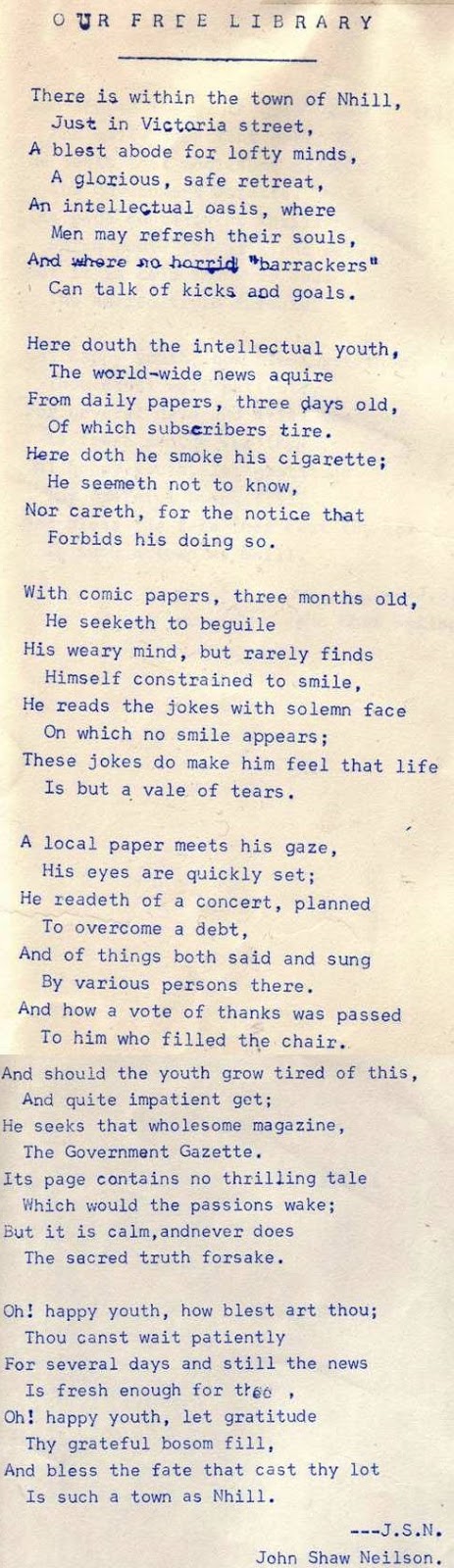
'Our Free Library"
![]() |
| Neilson biography by Hugh Anderson & Les Blake |
John Shaw Neilson was born on 22 February 1872 at Penola, South Australia, eldest son of Scottish-born John Neilson bush-worker and selector, and his wife Margaret, née McKinnon. Known as Jock, he attended the local school for less than two years and as a small child worked as a farm labourer for his father.
![]() |
| The Neilson's cottage originally at Penola, now re-constructed at Nhill |
In 1881 John Neilson senior and his half-brother Dave Shaw joined the South Australian farmers making the long trek by wagon over the border to take up selections under the Victorian Land Act and were each allotted 320 acres north of Lake Minimay.
In the first year on their Minimay selection, the Neilsons cleared 6 acres and ploughed, sowed and harvested by hand, but after deducting the money owed to the storekeeper found they had made £7 from the crop. Impoverished and bankrupt, they were forced to seek station work to exist, and only devoted their spare time to the selection where the family lived in a crude mud-plastered house for eight years. Neilson Senior asked for extensions to pay the annual rent year after year, until in 1888 the storekeeper foreclosed.
![]() |
| The John Shaw Neilson monument at Dow Well |
By June 1889 they had shifted to Dow Well, a few miles west of Nhill. Although he did his share of clearing and working the land, Neilson found time to wander the swamps and woodlands as a keen observer of nature, gathering eggs and listening to birdsongs, foraging for mushrooms, and tracking wild bees, and for some months went to school at Dow Well/Tarranginnie East State School in 1885-86, leaving when he turned 14.
Neilson and his father generally worked as farm-hands, timber-cutters, or roadmaking workers for the Lowan Shire council, but were also staunch unionists when shearing. Both belonged to the local literary society, and both won prizes for verse in the Australian Natives' Association competitions in 1893. Neilson Senior was a published bush poet, who appears to have started writing verse when he was about 30, and contributed to local newspapers and Adelaide Punch. He won another prize for verse in 1897, but achieved his widest popularity in outback shearing sheds with a song, 'Waiting for the Rain'. Although he lacked 'the outstanding poetical genius of his son', he was a writer of some achievement in the face of a lifelong bitter struggle for existence and little schooling; his verse was issued in book form, The Men of the Fifties, in 1938.
John Shaw Neilson wrote the poem 'Our fee library' about the Nhill Library.
Frank Shann, editor of the Nhill Mail, printed verse by Neilson for some years. Most was conventional and undistinguished. The family moved into Nhill in mid-1893, still deep in poverty and existing on municipal contracts and farm work, but by May 1895 they were on the road again travelling north to take up a scrub-covered Mallee selection near Lake Tyrrell, which had to be rolled and burned and grubbed before ploughing and sowing.
With poor health from heavy labouring work and failing eyesight Neilson moved to Melbourne, where he was employed by the CRB (Country Roads Board) in 1928.
John Shaw Neilson died on 12th May 1942 in Melbourne.
The Minimay Hall Committee is encouraging former school students to attend the celebrations. For more information and/or to book contact members: Geoff Carracher (53866261), Jenny Chenhall (0416264113) or Dick Smith (53866241).
Labels:
Events,
Historic buildings,
Libraries,
Minimay,
Neilson family,
Nhill,
poets
Subscribe to:
Posts (Atom)